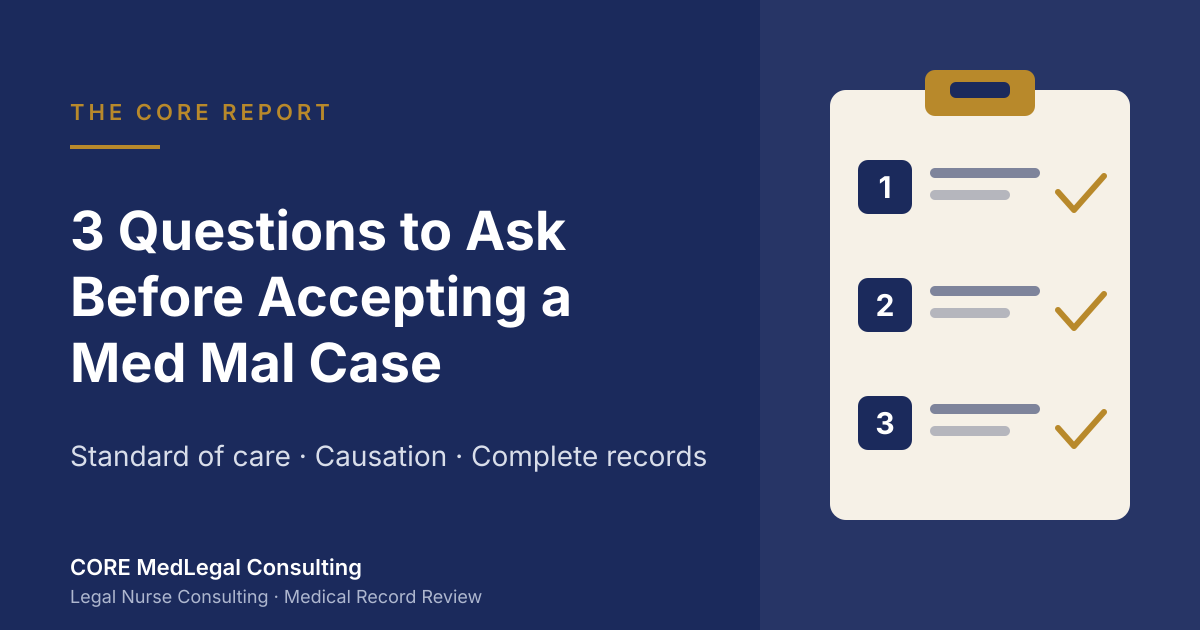
3 Questions to Ask Before Accepting a Med Mal Case
Standard of care, causation and record completeness: a clinical intake checklist.
By Sandy Harman, DNP, AGACNP-BC, ENP-BC, FNP-BC, LNC
Every medical malpractice case begins with a decision: take it on, or pass. For plaintiff counsel, that decision commits time, expert fees, and case costs that may not be recovered for years. For defense counsel and carriers, the same early clinical assessment shapes reserves, strategy, and whether a case is better defended or resolved. Either way, the decision is only as good as the clinical information behind it.
A structured case merit screening does not replace a full expert review. It is a focused, early look at the medical record to answer the questions that most often determine whether a case can be supported. In my work reviewing emergency, acute care, and primary care records, three questions come up again and again.
Question 1: Is there an identifiable departure from the standard of care?
A bad outcome is not, on its own, evidence of negligence. Patients can experience serious complications even when every decision was reasonable. The first screening question is whether the record shows a specific point where care fell below what a reasonably prudent provider, in the same role and setting, would have done.
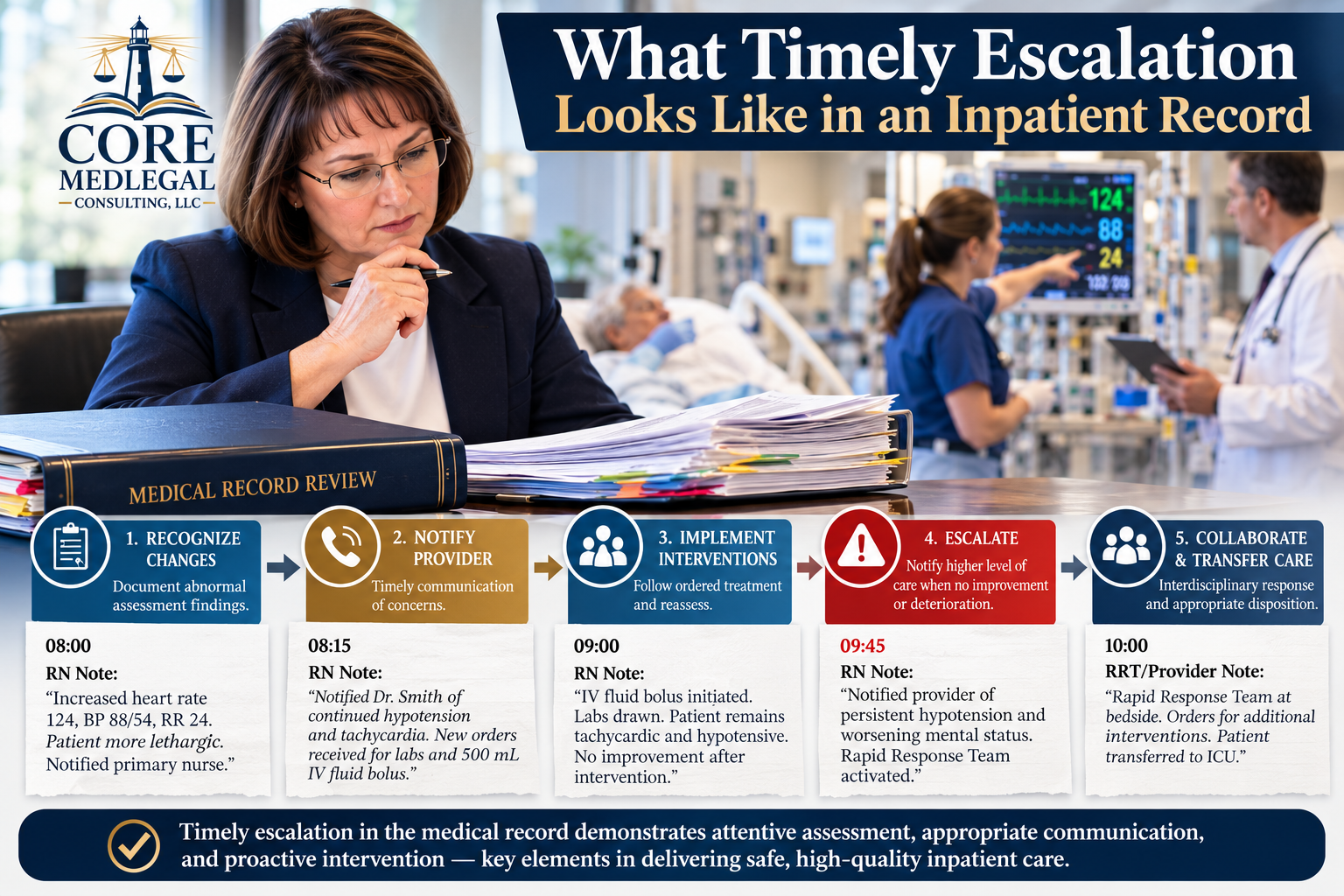
That requires identifying the decision points in the encounter: the assessment, the differential diagnosis, the orders, the interpretation of results, the treatment, the consultation or escalation, and the disposition. At each point, the reviewer asks what the provider knew or should have known from the information available at the time, not what became clear in hindsight.
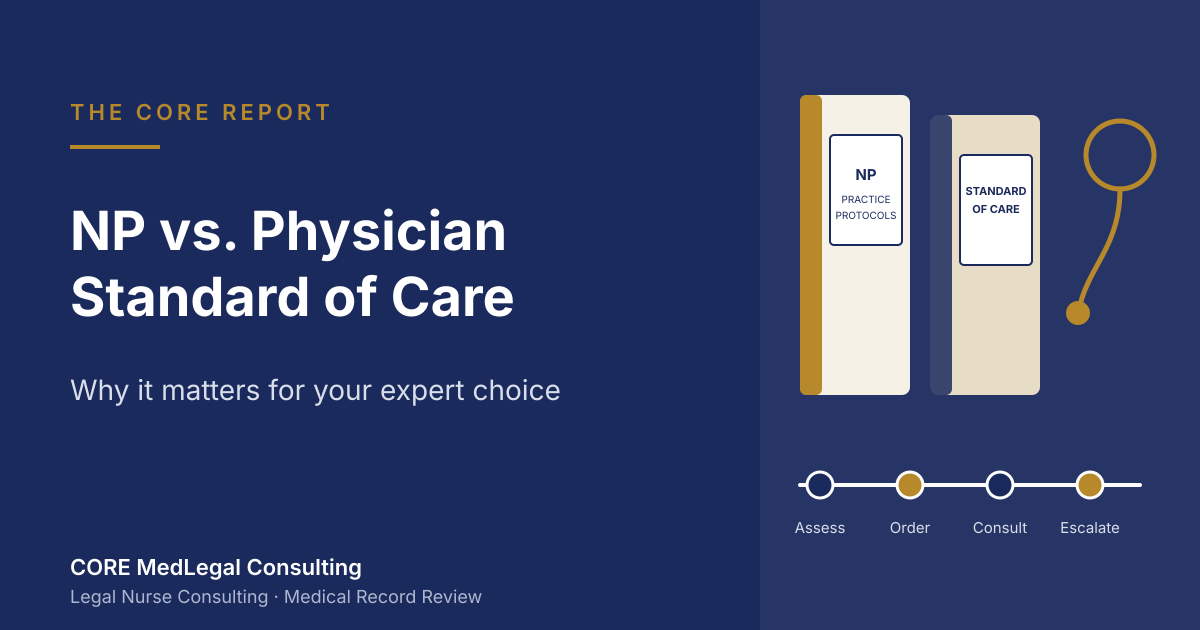
It also requires knowing whose care is at issue. An emergency department visit may involve a triage nurse, a nurse practitioner, a physician, and a consultant. Each is measured against the standard that applies to their own role. A screening that lumps them together can overstate or understate the strength of a claim against any individual defendant.
Question 2: Can the record support a link between the departure and the harm?
A departure from the standard of care matters in litigation only if it can be connected to the injury. This is often where cases that look promising at intake run into difficulty.
The screening questions here are practical. What was the patient's condition at the time of the alleged departure? What would likely have been done differently if the standard had been met? Is there a reasonable clinical basis to believe that different care, at that point, would have changed the outcome? Or was the underlying condition likely to progress the same way regardless?
Timing matters a great deal. A delay of several hours in one condition may have little clinical significance, while in another it may be the central issue. A clinician's early read on the timeline helps counsel understand whether causation is likely to be a strength or a battleground.
A nurse practitioner reviewer can identify clinical causation issues and flag them early. In many jurisdictions, causation opinions in health care liability claims are expected to come from a physician. In Texas, for example, Chapter 74 of the Civil Practice and Remedies Code requires claimants to serve expert reports within a set period after a defendant answers, and causation is generally addressed by a physician. Counsel should confirm the requirements that apply in their jurisdiction.
Question 3: Is the record complete, and does it tell a consistent story?
A merit screening is only as reliable as the records it is built on. Before forming any view on the first two questions, it is worth asking whether the file in hand is the whole picture.
Common gaps include missing nursing notes or flowsheets, absent medication administration records, outside records referenced but not produced, imaging reports without the underlying studies, and incomplete discharge or transfer documentation. In electronic records, there may be relevant information in audit trails, order histories, or results that were never displayed in the printed chart.
Consistency matters as well. Does the triage note match the provider note? Do the vital signs support the documented assessment? Are there late entries or addenda, and when were they made? Discrepancies do not automatically point to negligence, and they can cut either way. But identifying them early lets counsel request what is missing and avoid building a case theory on an incomplete foundation.
What a structured merit screening delivers
A useful screening gives counsel a clear, objective summary they can act on. That typically includes a brief timeline of the key events, the decision points that matter, an initial view on standard of care issues, causation concerns to explore with the appropriate expert, and a list of missing or inconsistent records to request.
Just as important, it should be candid. Sometimes the most valuable result of a screening is learning early that a case is not supported, or that the defense has a strong position on a key issue. That clarity saves time and resources for everyone involved.
Practical takeaways for attorneys
- Separate a bad outcome from a departure from the standard of care before investing further.
- Identify every provider involved and the role each played in the care at issue.
- Map the timeline early to see whether causation is likely to be a strength or a challenge.
- Confirm the record is complete, including nursing documentation, medication records, and audit trails where relevant.
- Check your jurisdiction's expert report and qualification requirements, and their deadlines, at intake.
- Ask for an objective screening, not one designed to confirm a preferred conclusion.
Talk through your next intake
If you are weighing whether to accept a medical malpractice case, or assessing a claim early on the defense side, I am glad to discuss what a focused merit screening could tell you. I work with both plaintiff and defense counsel, and every review is objective and grounded in the record. Schedule a complimentary consultation through the Contact page or call (972) 833-6275.